Industry has built video monitoring systems with a common assumption: stream everything to human operators for analysis. Emergency response teams expect real-time streams from multiple drones and body cameras. Industrial monitoring adds on-site cameras streaming to a centralized oversight that is scaled by adding more screens. These approaches assume that scalable network bandwidth exists and that human cognition can handle the increased monitoring demand. However, the reality is that network limitations exist and there is a cognitive load limit.
Network Limitations
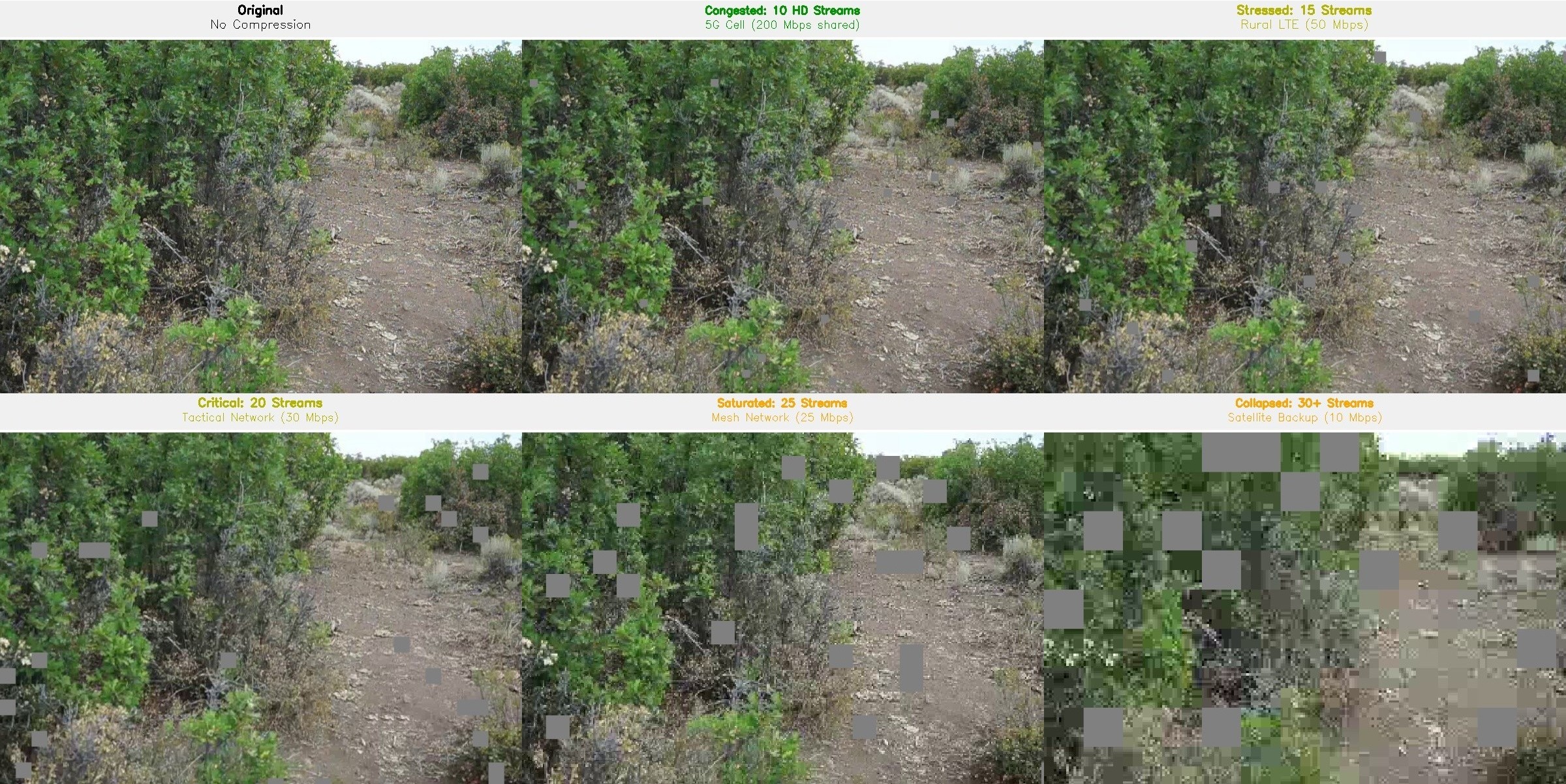
HD video streams consume 3-8 Mbps each. 4K content requires 15-25 Mbps per stream. These are physics, not negotiable requirements.
Network infrastructure does not meet these demands for all users. 5G networks deliver 200-400 Mbps shared among all users in a cell. LTE provides 10-150 Mbps total throughput divided among active users. Starlink, despite impressive rural performance with 200 Mbps median speeds, caps service to a few hundred users per 20-kilometer cell area due to capacity constraints.
Five simultaneous 4K streams require 125 Mbps total bandwidth. This consumes half of a typical 5G cell's shared capacity or exceeds available bandwidth entirely in rural deployments. Ten HD streams demand 50 Mbps - a requirement that exceeds the capacity of available networks in remote locations.
These calculations assume optimal conditions. Real networks degrade with distance, weather, interference, and user density. The bandwidth that exists in theory disappears in operational reality.
When confronted with bandwidth limitations, teams often turn to tactical mesh networks as a silver bullet. While these MANET radios excel at maintaining connectivity in challenging environments - urban canyons, mountainous terrain, contested spectrum - they fundamentally redistribute existing bandwidth rather than create new capacity. Each relay hop consumes bandwidth. Ten nodes sharing a mesh still compete for the same finite spectrum, whether through TDMA time slots, CSMA/CA contention, or frequency division. The total information capacity remains bounded by Shannon's theorem.
Software techniques can reduce the impact of this problem to some degree. H.265/HEVC compression reduces bandwidth requirements by 50% compared to H.264. Adaptive bitrate streaming reduces quality during congestion. Variable frame rates and resolution switching introduce latency. While these approaches do raise the ceiling on the number of streams they do not fully handle the load required as large operations scale.
Human Cognitive Bottlenecks
Stanford research on human cognition demonstrated that heavy media multi-taskers become more susceptible to distraction and perform worse in task switching tests. The FAA's research on air traffic controller workload found that performance degrades sharply beyond monitoring 2-4 simultaneous dynamic targets. Studies on video monitoring reveal that sustained attention degrades with multiple simultaneous inputs. Cognitive load increases significantly when operators process multiple visual streams.
Mental processing of multiple video feeds leads to reduced memory performance and increased error rates. Attention switching between feeds creates delays and missed critical events. These are fundamental human cognitive constraints - not training issues. Simply scaling the number of human operators is not a solution.
Organizations assume adding operators scales linearly with video inputs. Research shows the opposite. Beyond 2-4 simultaneous streams, additional feeds reduce rather than enhance situational awareness. Operators experience decision fatigue and miss critical events despite having more information available.
Real-World Failure Scenarios
Critical Infrastructure Monitoring
A multi-site industrial facility deploys 20 cameras across remote locations. Traditional streaming requires 100 Mbps continuous transmission. Rural cellular networks provide 10-50 Mbps shared capacity. The system is mathematically impossible before considering redundancy, latency, or degraded conditions. When primary links fail, the backup satellite connection offers 2 Mbps - sufficient for email, useless for video surveillance of critical infrastructure.
Search and Rescue Operations
Ground teams equipped with body cameras plus drone support generate four HD streams requiring 32 Mbps. Tactical satellite links provide 5-15 Mbps when available. Weather conditions, terrain, and electromagnetic interference reduce actual capacity further. During a recent multi-agency wildfire response, teams reverted to radio-only coordination after video streams consumed all available bandwidth, leaving no capacity for mapping updates or weather data.
Operational Reality
Current thinking often treats bandwidth as infinite and human attention as unlimited. Systems designed to work in lab conditions fail in operational environments. The solution is not increasing bandwidth or operators as these approaches do not scale and are cost prohibitive. Systems must be designed for bandwidth scarcity and cognitive reality.
Tell us what you are fielding.
Field testing, data collection, and integration for emerging technology.
Book a 30-minute call